Home Find your path My Approach About Me Contact
🇬🇧 · 🇪🇸
Confidential first session
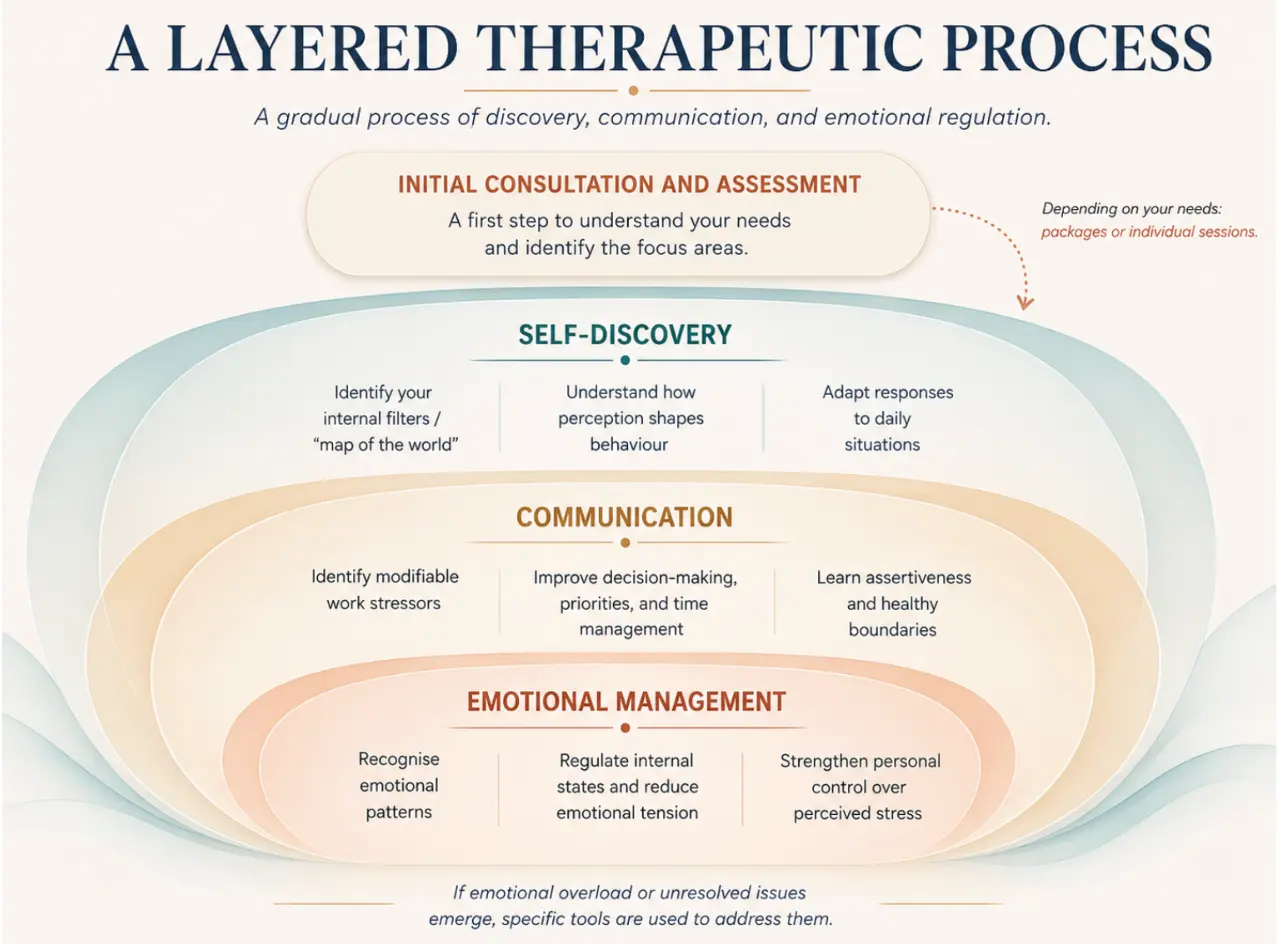
A layered therapeutic process

Because sometimes, we need a compass, a guide.

Because we cannot do it on our own. Because you are not alone.

Dr. Sara Beneit layered therapeutic approach for humanitarian professionals
The process begins by exploring the current situation that depletes your energy, inner harmony, and ability to be more efficient at work.

A gradual process of discovery about yourself and some relevant questions.

Explore the process

What does a layered process mean?

A gradual process of discovery about yourself and some relevant questions.

How do you react to an adverse and unexpected event?

What coping strategies do you know in case the situation you are facing does not fit what you expect from it?

How much personal control do you feel in order to reduce feelings of threat and perceived stress, and produce greater security?

How do you perceive your professional role?

What level of anxiety or unresolved emotional situations do you already carry in your baggage?

What level of anxiety or unresolved emotional situations do you already carry in your baggage?

Dr. Sara Beneit at her desk in her private psychotherapy office

You will learn or reinforce the coping mechanisms for the kind of job and context you have chosen to work in.

I will accompany you in a series of therapeutic sessions.

Depending on the area you need to reinforce, therapeutic packages can be offered or a series of independent sessions according to your needs.

We begin with the situation that depletes you.

I will accompany you in a series of therapeutic sessions. In the first session, which I call Diagnostic, we explore your current situation: the one that depletes your energy, inner harmony, and ability to be more efficient at work.

We address your needs and priorities through a tailored, solution-oriented therapeutic strategy.

Clarify what is happening emotionally and professionally.

Identify the internal and external stress factors that can be addressed.

Define whether therapeutic packages or independent sessions are the best fit for your needs.

Learn or reinforce coping mechanisms for the kind of job and context you have chosen to work in.

What tools are used?

I will offer different tools according to which ones you feel comfortable with and the most useful for you.

Neurolinguistic Programming techniques

To identify the internal filters you use to perceive the reality around you.

Ericksonian hypnotherapy

One of the tools used according to your needs, comfort, and the case at hand.

EMDR

Eye Movement Desensitization and Reprocessing can be used when unresolved emotional overload emerges.

Hemi-Sync and hypnosis-based meditation

To support meditation based on hypnosis and work with internal states.

The tool depends on what is most useful for you.

If during the process any unresolved emotional overload emerges, it will be addressed properly through the specific tools corresponding to the case at hand.

Dr. Sara Beneit in a private psychotherapy session

Three areas the process can reinforce

Depending on the area you need to reinforce, therapeutic packages can be offered or a series of independent sessions according to your needs.

Perception and internal filters

The first package will help you to identify the internal filters you use to perceive the reality around you. The result of this internal processing will determine the way you behave. This awareness will allow you to better adapt to each daily situation.

Stress factors and assertiveness

A second package, based on communication skills, will help you to identify the stress factors in your work environment susceptible to being modified. A decision-making tool will help you review your job priorities, manage your time in a more effective way, and make the appropriate efforts according to your real capabilities.

Emotional patterns and internal states

The third package explores strategies based on emotions, addressed to manage our responses and diminish the level of emotional tension produced by a stressful situation. We review each basic emotion and how they manifest in you as an emotional pattern.

There are no good or bad behaviors per se, but behaviors better adapted to each situation.
1

Your needs matter

To consider your needs as important as others' has a positive effect on your stress level and emotional status.

2

Personal control reduces threat

Achieving a proper degree of personal control helps reduce the threat of stress or the level of perceived stress.

3

Unresolved overload is addressed

If unresolved emotional overload emerges during the process, it is addressed through the specific tools corresponding to the case at hand.

The only two things you may change are what you feel and the way you behave.

Start with a confidential diagnostic session

We use the first session to understand your situation, your needs, and the kind of support that would be useful now.

Write to me instead